I blogged a while back on the unsuspected hazards that might lurk in books, and the seemingly draconian regulations posted in library books in days of yore to deal with them.
Alas, it seems that the poor souls who drafted those regulations missed a trick: they did not consider the possibility that children's books might be actively dangerous in themselves, not just because of the dreadful germs they might have encountered. In America, any children's book published before 1985 is now considered an active menace to children, and may not be sold. The Consumer Product Safety Improvement Act (CPSIA) is now in force, and has imposed very tight limits on the amount of lead any article bought for a child may contain. Books produced before 1985 may have had lead used in their printing inks, and hence the prohibition. Note the may there - some have lead, some haven't, so the law has helpfully produced a way round to stop you throwing away books you can actually sell. You pay for the book to be lead tested - and this is apparently not cheap.
There is an exemption for books which might be thought of as collectible, and so read by adults and not children, but all over America thrift stores and libraries are tarping off pre-1985 books, or throwing out the illicit child poisoners. If they don't, they risk a $100,000 dollar fine and maybe even imprisonment.
It seems absolutely mad, doesn't it? The nanny state gone completely stark, raving bonkers. The CPSIA was apparently sparked by the Chinese toy scandals: which I can entirely see - no one wants illegal lead in toys, but books? Surely you're more at risk from a vicious paper cut from a book than lead poisoning.
And if it's illegal to expose a child to lead in a pre-1985 book, I do wonder what this means for books people actually have in their houses now. Perhaps the children of bookdealers who work from home will be whisked off to safety until their homes can be de-contaminated.
So, here I sit, in what American legislators would probably consider a toxic fug, surrounded by piles of lethal literature. No wonder the dog's just insisted on going outside. Read more about the law here, here, and here.
Friday, February 27, 2009

Wednesday, February 11, 2009
Footsteps in the Dark by Georgette Heyer

Georgette Heyer is best know for her Regency romances where her combination of historical detail and witty characterisation won her many fans. She also wrote twelve detective stories; Footsteps in the Dark is the first of these.
Footsteps in the Dark is a very readable and enjoyable volume if you are Heyer fan or otherwise know what to expect. Three siblings inherit an old house, The Priory. Peter, Margaret and Celia together with Celia's barrister husband and an aunt move into the building with the idea of a long vacation. However, things don't go as planned. Things, instead, literally go bump in the night: monk-like ghosts flit around the garden and someone is found dead. Is the explanation supernatural or criminal? Well, no prizes for guessing.
If you start this book expecting cutting edge plot or gritty realism you'll be sorely disappointed. What we have here is escapism criminology. The plot is a little thin, so what keeps you reading, as always with Heyer, is the characterisation, the witty asides, the flashes of realism in relationships. The majority of the book is laden with every cliche from secret passages to bits reminiscent of Mrs Radcliffe's much parodied Mysteries of Udolpho. In fact, so busy with such fussy fancy is the plot that one almost expects Scooby and Shaggy to appear looking for a snack in the castle kitchens. Instead we have unflappable Aunt Lilian who bears a strong resemblance to some of Bertie Wooster's aunts.
This was Heyer's very first detective novel and it shows, but provided you are prepared for all the pseudo-medieval fixtures and fittings, it is still a great duvet read. By the time Heyer wrote her next crime work her husband was a barrister and her plots had improved. So, if you've read this and didn't like her work, do try another as it is not typical. I think my favourite is Detection Unlimited.
This review is crossed posted at the Georgette Heyer Challenge. You might also find the article Georgette Heyer - Queen of Mystery and Suspense by Margaret Rogers of Hessay Books interesting. It is one of the collector's guides listed in the bar on the left.
Sunday, January 25, 2009
Getting Things Done

I spotted this little gizmo via Harriet Devine's excellent blog. It analyzes writing style not personality. Good job too as with multiple-contributors the overall personality will be nebulous to say the least. But apparently the writing style(s) of the ibooknet blog suggest we're:
ESTP - The Doers: The active and playful type. They are especially attuned to people and things around them and often full of energy, talking, joking and engaging in physical out-door activities.
The Doers are happiest with action-filled work which craves their full attention and focus. They might be very impulsive and more keen on starting something new than following it through. They might have a problem with sitting still or remaining inactive for any period of time.
The Doers are happiest with action-filled work which craves their full attention and focus. They might be very impulsive and more keen on starting something new than following it through. They might have a problem with sitting still or remaining inactive for any period of time.
In common, no doubt, with many bookselling households Sunday night here is always a whirl of activity, parcelling books from two days of sales instead of just one, so "doer" seems appropriate this evening. A worrying level of multi-tasking takes place as I am also a mother, but I have yet to pack a copy of Derrida into my 5 year old's lunch box, and post cheese sandwiches to a University library, so I guess I am a successful 'doer' in that respect at least.
As to the rest, "physical out-door activities" was a bit of a shock (that'll be Jane and her chickens), and as for "problem with sitting still or remaining inactive " - we're bookdealers, it's what bookdealers do best!
You can typealyze your own blog here.
Monday, January 19, 2009
The Ibooknet Menagerie - 1
Bookdealing can be a solitary occupation, but between us, Ibooknet have a pretty extensive collection of office animals keeping us company. First up in what we hope will be a series in between more bookish things, is Rosie, of Barbara Fisher's March House Books, specialists in children's fiction and illustrated books.


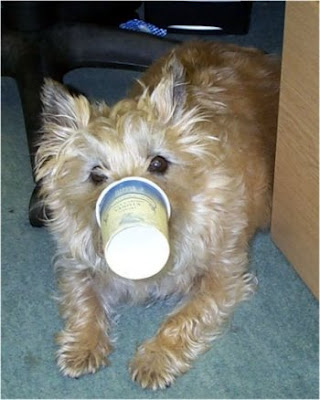
The yoghurt pot was filched from the waste basket but unfortunately for Rosie it got stuck – if she could speak I’m sure she would be saying - it wasn’t me!"
"Rosie is our dearly loved Cairn terrier – estimated age 20!! She came to live with us 5 years ago and we were told she was around 15 at that time. She was a kennel dog for the first 8 years of her life then lived with various families before ending up with our son and daughter-in-law – work took them to Denmark and so we agreed to look after her ‘for a while’. Shortly after that they moved on to Australia so Rosie became a permanent fixture. As you can see from the photos she is still capable of mischief but spends much of her time asleep in her basket. Her hearing and eyesight are failing and she has problems with her breathing but she still loves life.
The yoghurt pot was filched from the waste basket but unfortunately for Rosie it got stuck – if she could speak I’m sure she would be saying - it wasn’t me!"
Saturday, January 17, 2009
The Thirteenth Tale by Diane Setterfield

The Thirteenth Tale by Diane Setterfield is, on the whole a very readable book. I had heard some mixed reviews, which I think helped as I approached the book with fewer expectations, and in truth I was able to suspend disbelief and rattle along with its Gothic intricacies very happily. I don't think the book was done any real service by the pre-publication publicity; don't expect to love it and you might find that nonetheless you like it very much indeed.
Like the even more readable The Shadow Of The Wind by Carlos Ruiz Zafon the main character/ narrator Margaret Lea is employed in the family bookshop and engaged by a book and a mysterious author Vida Winter, sets off on a quest to discover more. Margaret Lea is a minor biographer whose diligence brings her to the attention of the aging and immensely popular reclusive novelist Vida Winter. Miss Winter has never told the truth about her past but now she is about to do so for the first time. With Margaret Lea we follow this narration of dysfunctional families, uncontrollable children, incestuous love affairs, and people in attics, house fires and decaying buildings. Margaret channels Vida's narration, comments on it, digests it, propels our thoughts forward and backward through the possibilities surrounding the mystery, and on balance this is handled very neatly. We also follow Margaret in the present as she make discoveries herself, though this is less neat as Margaret is quite a thin character who lacks bite within the narrative and a convincing life away from her narratorial role.
Read it as an acceptable jobbing work of suspense or a workaday Gothic thriller and The Thirteenth Tale is a fine enough book. It is laced with Gothic allusion (it doesn't take a genius to spot the Brontes and Daphne du Maurier), it is fairly pacy, the narrative tricks and turns are generally pulled off, and the denouement came as a surprise. The surprise was in part I think was because it is only a fraction of an inch this side of plausible, but it is just about plausible, so I did not feel too cheated. It is not fine art but it is a fine Sunday afternoon read. One of the most annoying things was a lapse into a tell rather than show method of characterisation on occasion, and as Geranium Cat says, it is hard to differentiate between Margaret's voice and Vida's. If you approach the book not expecting Jane Eyre then this is not a problem, but I wouldn't like to give it an unequivocal recommendation for that reason. Some like it; some don't.
It was published too close to The Shadow of the Wind I think to have been directly influenced by it but it has many similar features. I preferred The Shadow of the Wind despite some of the trite narratorial quirks like posthumously letters of improbable length solving part of the mystery. I think there are two reasons for my preference: firstly Lucia Graves's (daughter of Robert) translation seems very elegant (I have no idea what the original Spanish literary qualities were like), and secondly the main character is more firmly part of an active narrative and has a distinct personality and feelings, rather than being a device for communicating like Margaret Lea.
Having said all that, on the basis of The Thirteenth Tale I would be very interested to see what Diane Setterfield does next. She is really a very good story teller and I look forward to with what, and how, she weaves her next tale.
If you are interested in Diane Setterfield then you might also enjoy this article by Sally Mackenzie of Macbuiks, which is one of our Collector's Guides over on the left.
Like the even more readable The Shadow Of The Wind by Carlos Ruiz Zafon the main character/ narrator Margaret Lea is employed in the family bookshop and engaged by a book and a mysterious author Vida Winter, sets off on a quest to discover more. Margaret Lea is a minor biographer whose diligence brings her to the attention of the aging and immensely popular reclusive novelist Vida Winter. Miss Winter has never told the truth about her past but now she is about to do so for the first time. With Margaret Lea we follow this narration of dysfunctional families, uncontrollable children, incestuous love affairs, and people in attics, house fires and decaying buildings. Margaret channels Vida's narration, comments on it, digests it, propels our thoughts forward and backward through the possibilities surrounding the mystery, and on balance this is handled very neatly. We also follow Margaret in the present as she make discoveries herself, though this is less neat as Margaret is quite a thin character who lacks bite within the narrative and a convincing life away from her narratorial role.
Read it as an acceptable jobbing work of suspense or a workaday Gothic thriller and The Thirteenth Tale is a fine enough book. It is laced with Gothic allusion (it doesn't take a genius to spot the Brontes and Daphne du Maurier), it is fairly pacy, the narrative tricks and turns are generally pulled off, and the denouement came as a surprise. The surprise was in part I think was because it is only a fraction of an inch this side of plausible, but it is just about plausible, so I did not feel too cheated. It is not fine art but it is a fine Sunday afternoon read. One of the most annoying things was a lapse into a tell rather than show method of characterisation on occasion, and as Geranium Cat says, it is hard to differentiate between Margaret's voice and Vida's. If you approach the book not expecting Jane Eyre then this is not a problem, but I wouldn't like to give it an unequivocal recommendation for that reason. Some like it; some don't.
It was published too close to The Shadow of the Wind I think to have been directly influenced by it but it has many similar features. I preferred The Shadow of the Wind despite some of the trite narratorial quirks like posthumously letters of improbable length solving part of the mystery. I think there are two reasons for my preference: firstly Lucia Graves's (daughter of Robert) translation seems very elegant (I have no idea what the original Spanish literary qualities were like), and secondly the main character is more firmly part of an active narrative and has a distinct personality and feelings, rather than being a device for communicating like Margaret Lea.
Having said all that, on the basis of The Thirteenth Tale I would be very interested to see what Diane Setterfield does next. She is really a very good story teller and I look forward to with what, and how, she weaves her next tale.
If you are interested in Diane Setterfield then you might also enjoy this article by Sally Mackenzie of Macbuiks, which is one of our Collector's Guides over on the left.
Wednesday, October 15, 2008
Blast! Sold it!
 One of the rules of selling used books is that if you fancy reading one of your books in stock someone buys it. In fact the best way to get a sale is to start reading a book and get really engrossed then, about 50 pages from the end, you'll sell it.
The book in question here was neither rare nor expensive and will no doubt come my way again but I really did fancy reading A Passionate Sisterhood: The Sisters, Wives and Daughters of the Lake Poets by Kathleen Jones. Generally I am not fond of multi-person biographies, as I think reading three biographies on three inter-related people gives a more interesting picture than one book trying to turn in too many directions at once. For example the Ted Hughes - Sylvia Plath - Assia Wevill triangle is better represented by Bitter Fame by Anne Stevenson (Plath), Ted Hughes by Elaine Feinstein and A Lover of Unreason by Yehuda Koren and Eliat Negrev (Wevill), than it would be any one biography trying to deal with all three complex personalities at the same time. If you're wondering if it gets boring reading biographies of such close subjects one after the other, well actually I don't think it does. You get such a different perspective. Earlier this year I read Mrs Gaskell's Life of Charlotte Bronte and I have just finished The Infernal World of Branwell Bronte by Daphne Du Maurier. I feared it would be more of the same, but actually it throws Branwell into much sharper relief, gave me a new perspective on Charlotte and made me want to acquire a separate biography of Anne Bronte too.
Back to the book I have just sold, A Passionate Sisterhood is a look at the lives of the women of the Romantic poets: Robert Southey, William Wordsworth and Samuel Taylor Coleridge. The women are sisters, cousins, friends and in-laws: Sarah, Mary and Edith Fricker who married the friends Coleridge, Robert Lovell and Southey, Dorothy Wordsworth, Sarah and Mary Hutchinson (Mary was later Mrs Wordsworth) and the children of these relationships. The Romantics did live such interwoven lives: in and out of each other's houses (often living in the same house actually), partners in art and thought, as well as relations suffering the trials of mixed financial fortunes, drug addicted spouses and more. A combined look at the 'sisterhood' seemed such a good premise for a book. But it has gone, though no doubt to a good home, and next time I have it in stock I will get onto it quicker!
Thursday, October 9, 2008
And the winner is ...
Thank for your entries everyone. Using the traditional drawing of paper out of a hat we have a winner for the draw ...
Tanabata!
Please get in touch and I will send you the book.
Tanabata!
Please get in touch and I will send you the book.
Subscribe to:
Posts (Atom)


